Thursday, December 5, 2013

Saturday, April 20, 2013
Raymond Carver and Charles Bukowski Meet in the Desert in 1962
 |
| Targets no. 11. Sandia, New Mexico, 1962 |
This issue of the fugitive and important western little mag is notable for featuring the first poem published by the young Raymond Carver, 'Brass Ring'. Carver was notified of the acceptance of the poem on the same day that he received notice of the publication of his regularly first published story, 'Pastoral' in the Western Humanities Review. [Sklenicka p. 84]. Maryann Carver, Raymond's first wife, would later say of that day "We were on top of the world. It seemed that if you did the right things, the right things would happen. . . We were ecstatic and partied for three days." [Halpert p. 62]
This issue of Targets also features the Charles Bukowski poem "Our Breath's Fondness Burns Like Gruel in Beggary".
In his Summer 1983 interview with Mona Simpson and Lewis Buzbee in the Paris Review, Carver said of this publication that "Charles Bukowski had a poem in the same issue, and I was pleased to be in the same magazine with him. He was a kind of hero to me then."
It's fascinating to see them under the same covers in the same magazine this early, because Carver and Bukowski would take different paths in their literary careers. While Bukowski would repeatedly celebrate his outsider status and publish mainly for little mags and small presses, Carver would struggle to put himself through school at Chico State and would go on to spend considerable time as a teacher and lecturer. Carver's early work did appear in the small press scene, notably his excellent second book, Winter Insomnia, which was published by George Hitchcock at the legendary Kayak Press. Beginning in the mid 70's, though, the bulk of Carver's work would be published by large, mainstream presses.
Carver would eventually meet his hero a decade later, when he invited him to give a reading at UCSC in 1972. The reading and the following party turned into a drunken shamble, documented on pages 208-9 in Sklenicka, which quotes Mort Marcus' account of the party. - "Bukowski, drinking everything in sight, muttered, bragged, cursed, and, getting drunker by the minute, grabbed the girls and mashed his whiskery ace against theirs, or shot his hand to the crotch of their jeans or down their blouses. . . girls screamed and ran from the house. . . more cerebral students sat back and stared straing ahead, probably stoned. . . Ray started drinking."
Out of that evening would come the considerably more nuanced view of Bukowski in the Carver poem "You Don't Know What Love Is (An Evening With Charles Bukowski) in which he incorporates many lines that Bukowski spoke at the party into his own poem, including phrases derisive of the college literary scene. Critics differ on whether the poem is a tribute or a satire. It's likely a bit of both, and one of the more fascinating poems I've ever read dealing with the struggle of influence.
Garner, W. L., ed. Targets 11. Sandia Park, N. M. : Targets, 1962. First edition. 8vo, 39 [1] pp., offset printed; saddle-stapled in card wraps. Some toning to wraps, with a 1" crease to upper rear tip. SOLD.
Tuesday, April 9, 2013
Alexandre Grothendieck and Survivre et Vivre
 |
| Survivre et Vivre
Survivre et Vivre was a radical environmentalist magazine which was issued c. 1970-73, and published by the group of the same name, formed by the eccentric genius and founder of modern algebraic theory - the mathematician Alexandre Grothendieck, certainly one of the most fascinating figures in modern science. At least 19 issues were published. I've been on the lookout for this magazine for several years, and have only been able to track down numbers 11-19. OCLC locates holdings only at the BIBLIOTHEEK UNIVERSITEIT Van Amsterdam and the Bibliotheque Internationale.
Grothendieck was born in Berlin, the son of anarchist parents. He was opposed to the war in Vietnam, and is famed for having lectured in the forest surrounding Hanoi as it was being bombed. In 1970 Grothendieck left the world of institutional mathematics over a dispute over military funding of the institution he taught at, the IHES. At this time he formed Survivre et Vivre.
Grothendieck is rumored to now be living in isolation, perhaps in the Pyrenees. During this time a number of manuscripts he is purported to have written have emerged in limited circulation, some on apocalyptic or milennarian themes. In 2010 he is reported to have declared that all of his works published since he left academia were published without his permission, and requested that duplication of his work cease, and that libraries containing his later works should remove them.
The graphics of Survivre et Vivre seem to betray an influence from Situationism, featuring satirical underground comics, collages, and detourneed comic strips and advertisements. In these issues I find work by Grothendieck, Jean-Marie Damais, Francois Maille, Didier Savard, Denis Guedj, D. Meuret, Robert Jaulin, and Louis Dewez. I can't find any writings on the magazine in any language, and in a way this post is something of a cry for help - I'm looking for anybody who might know anything about this strange magazine, which seems conspicuously absent from any account of the underground press during that period. Send me an email.
|
Friday, March 8, 2013
"This is the shock of recognition of all global hipsters!!
 |
| Add caption |

The manifesto takes the form of a dialogue, largely between Weissner and Georgakas. "This is the shock of recognition of all global hipsters!! ..: This Is The Intergalactic-Supernebulae-Beyond-Timespace-UBER-Everythingkeit : GEIST!!! the word. . . "

Georgakas, Dan & Carl Weissner, Frederike Poessnecker. Manifesto for the Grey Generation. Heidelberg: PANic, 1966. First edition. Oblong 4to, dittoed and silkscreened pages stab-stapled and tape bound. illustrated with two internal silkscreens in addition to the cover silkscreen. Some almost imperceptible smudging to cover, else fine. SOLD. Inquire.
Friday, November 9, 2012
Money-making Schemes of the Avant-Garde

Exhibition announcement for a solo show by Maciunas at his seminal AG Gallery, the gallery Maciunas himself founded with Almus Salcius. Legend has it that Maciunas intended to bankroll the avant-garde programming of the gallery by importing luxury foodstuffs from Europe, but neither the art nor the food was enough to keep the gallery open; it would close in July of 1961, after having been open for less than a year. In that short time, however, Maciunas was able to show the works of future members of the Fluxus movement. Scarce, very early Fluxus ephemera from a short-lived but influential space.
Maciunas, George. Works of George Maciunas At A. G. New York: A. G. Gallery, [1961]. First edition. 3.5 x 10,.5" exhibition announcement, offset printed on card stock. Near fine. SOLD.
Friday, September 14, 2012

Thursday, September 13, 2012
Two from the The Archangel Press

This year I finally tracked down a copy of Abraham Lincoln Gillespie's The Shaper, which is as far as I know is not only the first separately published work by the poet, but also the only work published in his lifetime. The Shaper was published by the Archangel Press, a press I know nothing about, but which published another one of my favorite books of visual poetry - Kenneth Lawrence Beaudoin's 6 Eye Poems.

Today I got to put the two works, which are presented in a uniform format, side by side. Both are among the strangest, most overlooked works of visual poetry that I know of, and represent a little documented strand of visual poetry in the United States.
Gillespie was a member of the group that centered around Transition Magazine in the 20's and 30's. His work not only eschewed standard spelling and punctuation, it incorporated symbols and drawings and resembles musical notation. A selection of his work appeared in the third issue of Beaudoin's little magazine Iconograph, and was the only section of the magazine that had to be mimeographed, as the printer couldn't handle the eccentricities of the piece.
 |
| Detail from The Shaper |
Beaudoin's 6 Eye Poems consist of visual poems made out of collaged pieces of text laid over abstract drawings in colored pencil. The words appear to have been laboriously clipped out of magazines. On the title page Beaudoin claimed to have made 6000 of them. The poems are by turns beautiful and wry witty, but what is truly remarkable to me about them is that they were conceived of as a protest against the economies of printing. Here is Beaudoin's prefatory statement -
"I have gone through the laborious and expensive procedure of constructing 6000 individual EYE POEMS in vrai collage not because I regard it a media practical for the reproduction of poems despite the possible controls over poetic tone in printed words as opposed to the abstract word. I regard this little adventure in vral collage rather a protest against an economy which forces a poet to resort to the use of second hand print while the "new nightgown" or the "new bra" can command the most elegant available. Those of you who buy these poems may find them thin, fragmentary, as poetry, possibly not even successful decor. But you may also as I have in the manufacture of poems, derive a certain satisfaction in possessing an example of protest against an irresponsible economy."
Beaudoin was one of the early and important publishers on the beginnings of the Mimeograph Revolution in the 30's and the 40's, especially the strand which grew out of the pacifist movement. 6 eye Poems are a co-option and subversion of the language of mainstream advertising at a primal and beautiful level. With their commentary on consumer printing, they represent a strange but essential part of the story of the art of the Mimeograph Revolution.
 |
| Detail from 6 Eye Poems |
Beaudoin, Kenneth Lawrence. 6 Eye Poems. New York: Archangel Press, 1948. First edition. 4to. Six unbound collages and a title page mounted on black paper, housed in a printed envelope. Contents near fine with some minor toning and bumping to tips; envelope good only, with foxing, creasing, and tearing, but generally sound and intact. SOLD
Gillespie, Abraham Lincoln. The Shaper. New York: Archangel Press, 1948. First edition. 7 leaves, offset printed on thick card stock and housed in a printed envelope. Cards near fine with some light creasing and toning to margins; Envelope good only, heavily toned and chipped at margins, with some splitting. SOLD.
Tuesday, June 19, 2012
The Cleveland Manifesto of Poetry, The Asphodel Bookshop and the Future of Bookstores
 |
| The Cleveland Manifesto of Poetry |
The Cleveland Manifesto of Poetry was published from Jim Lowell's Asphodel Bookshop in 1964, a year after the bookstore opened at 465 The Arcade. It prints statements by Russell Atkins, d. a. levy, Russell Salamon, Adelaide Simon, Jau Billera, and Kent Taylor. The statements still seem relevant today, especially those of Atkins and levy, whose manifesto begins "To write surface poems with the appearance of artificial flowers in order to communicate with persons by forcing them to resort to instinctive methods of understanding." It is a beautiful and surprising characterization of the concrete tendencies in levy's poetry and bookmaking.
Lowell and the bookstore are credited at the top of the manifesto, but in reverse, so the attribution is best read in a mirror. This was perhaps one of the first contrary moves the store made, but certainly not the last. The Asphodel Bookshop went its own way, most famously during its 1966 censorship battle with the police. In doing so it sheltered and developed the local poetry scene to such an extent that it is impossible to imagine the Mimeograph Revolution in Cleveland without it.
This wasn't a new role for a bookstore. There is a rich and well-documented history of bookstores helping to develop literary scenes, including censorship issues. But this wasn't Paris or San Francisco. What seems truly remarkable about the Asphodel is what it accomplished in relative geographical and cultural isolation. In this regard it reminds me of another bookshop I've been researching, Judson Crews' Motive Bookshop in Waco, Texas, which sheltered a number of little magazines of the Mimeograph Revolution in the years leading up to World War II.
The isolation of these small, curatorial pioneer shops gave them increased importance to their local scene. They filled a role similar to the one played by local record stores in the seventies and eighties. In fact, Ohio record stores such as the Drome in Cleveland and Garbage in Kent played a crucial role to the Cleveland Punk and Ohio zine scenes, and it would be fascinating to find out if Asphodel was, even in some small way, an inspiration for those stores. For the past few years I've been researching shops like these for an exhibit that we'd like to have some day about the important role of such venues. These small, curated spaces of the past also point out a possible path for bookstores in the future. We live in an economic era in which large, general bookstores have become very difficult to operate successfully, but I think that there will be space in the future for small, curated spaces that will once again play an important role in supporting local art scenes.
In the case of the Asphodel, this curatorial aspect was also extended through the mail in the form of the mimeographed Asphodel catalogs, which often also printed work by poets, and are as important as any other little magazine of the Mimeograph Revolution. I never got to see the Asphodel Bookshop, but I keep a stack of the old catalogs handy and reread them often. They remind me of the power that a good book catalog can have. I was turned onto literature and bookselling when I was lucky enough to be handed a stack of bookselling catalogs by a neighbor when I was a teenager.
 |
levy, d. a. & Russell Atkins, Russell Salamon, Adelaide Simon, Jau Billera, Kent Taylor. The Cleveland Manifesto of Poetry (Principles Behind the Writings of 6 Cleveland Poets). [Cleveland]: [Asphodel Bookshop], 1964. First edition. 8 1/2 x 11" sheet, mimeographed in green from typescript at both recto and verso. Two holograph corrections in blue ink, presumably as issued. Fine. SOLD.
Wednesday, June 6, 2012
MS. A Literary Workshop

-->
Wright,
Talbot & Stephen Matthews, eds.
MS. A Literary Workshop. Los Angeles: Ms. A Literary Workshop, 1940-44. 8vo. First two issues each two folded, unbound sheets
mimeographed from typescript on rectos only; subsequent issues mimeographed
from typescript and drawing on both recto and verso, and saddle-stapled in
printed card wraps. Final four issues offset printed. Some moderate
dampstaining to no. 5, else all issues very good with expected toning.
After a long search, I was able to track down what I believe to be all issues published of this early west coast little magazine
of the Mimeograph Revolution, published "on behalf of the new writers of Southern California". Editorship is not explicitly named in any issue; the
correspondence address for the first two issues was Talbot Wright, and changed
to Stephen Matthews for subsequent issues. MS. belongs to that strain of the
Mimeograph Revolution which developed out of the anti-war sentiment of the
Second World War (such as Untide and Compass). MS. published the work of
renegade poets who worked well away from established literary centers, using
the technology of Mimeograph to overcome their geographical isolation, in
common with such magazines as Judson Crews’ Motive, and the first version of
Kenneth Beaudoin’s Iconograph – MS. shared writers with both of those
publications, and also Crescendo, Matrix, etc. This strand of the Mimeograph
Revolution that happened in the forties away from the established literary
centers deserves its own book length study, as most of these magazine are
criminally overlooked.
Primarily a literary
magazine, later issues also included some woodcuts and linocuts, including some
beautiful linocuts in red by Connie Stengal in issue 8.
 |
| Linocuts by Connie Stengal |
Issue 10 includes some very early
work by Jay Rivkin, predating her better known assemblage work (the
biographical note here states that Rivkin “attended no art school, does pottery
and greeting card art.")The magazine was notable for the inclusion of a higher
than normal ratio of women contributors, and it also included contributions
from a number of active and retired members of the armed forces.
The masthead of issue 9 notes that included the
magazines Perspective, The Morgue, Newsletter, and Memo. At this point the war took a heavy toll on little magazines. In issue 8 the
editor announced the beginning of his own service, and around this time changed
the spelling of his name to “Steven Matthews” (unless editorship actually passed to another
individual). Issue 9 bore a lament on the difficulties of publishing the
magazine while in active service.
At least one further number was published, no. 10, in
’43 or ’44, which was perhaps the most politically involved issue. It includes
the poem “Dig the Grave Deep”, by an anonymous Polish Guerilla, and a protest
against the concentration camp internment of Japanese Americans by Harry Yanos,
with three letters from Japanese Americans. No editors or correspondence name
is listed for this issue. The contributor notes were written by Jack Hughes. In the shop talk
section, Alan Swallow lists the fellow little magazines that had ceased
publication due to manpower and paper shortages; also, “Finding worthwhile
material is troublesome with so many writers in the military.” We are aware of
no further issues of the magazine; perhaps it fell prey to the same wartime
stresses that caused so many fellow magazines to cease publication.

Authors published across the numbers include Stephen
Guy, Oliver Sudden, Max Bowman, Gregory Ames, Leo W. Fielding, William
Peterson, Mark Keats, Josephine Ain, J. Andrews, Ralph Lee, Leo Baefsky, Sidney
Siegel, Harry Cimring, Leonard Lickerman, Gilbert Romaine, Robert Thorson, Mata
Rae Friedman, Victor Tarrish, Cecile Kyle, Richard Lake, Ben Macin, Mark Keats,
Steve Pratt, Catherine Ruth Smith, Joseph Crowley, H. N. Baker, Connie Stengal,
Elizabeh Knapp, Mary Graham Lund, Oscar Collier, Rita Michaels, Veta Griggs,
Sylvia Logan, Marion Lee, Manfred Carter, Raymond Kresensky, James Franklin
Lewis, Jay Rivkin, Irving Meyers, Fritz Eichenberg, Judson Crews, Kenneth
Beaudoin, Wendell Anderson (very early work, done while he lived in Oregon),
Scott Greer, Charles Angoff, Alan Swallow, and Taro Suzuki (a member of the
Nisei Writers Club). Hoffman et al. p. 354 (though they were only able to find
two single issues to consult).
-->
OCLC locates six holdings, most of which
appear to be incomplete, and none which note an issue past no. 10. Decidedly
uncommon. SOLD.

Friday, June 1, 2012
Hard Times are Coming to Your Town: KDAY, Run-DMC and the Day of Peace in Los Angeles

Run-DMC didn't get a chance to perform at their Long Beach show with the Beastie Boys on the Raising Hell tour in 1986. Fights between rival gang members broke out into a full fledged riot before they hit the stage. Police took half an hour to respond, by which time one audience member had been killed and scores wounded.
Following these events, Ed Kirby, the station manager for the pioneering radio station KDAY, and the members of Run-DMC came up with the idea for a day of peace, hosted by the radio station. On October 9, gangs were urged to lay aside their rivalries for the day. A symposium was held on KDAY with the members of Run-DMC to address gang and drug problems.
The sheer volume of call-ins, estimated at 15,000 in the publication, overran the local switchboard. No serious violence was reported on the date. About two weeks later, the Bloods and the Crips signed a peace treaty.

The document is partially reproduced in this booklet, which appears to have been produced to commemorate the event and to advertise the radio station's programs and place within the local Hip Hip community. The event was held as model for other cities in their attempts to curb gang and drug violence, which perhaps explains how this copy ended up more than 2000 miles away in the wilds of Detroit, where I found it beneath a huge pile of yearbooks.

[KDAY]. KDAY: A Day of Peace. [Los Angeles]: KDAY, [1986]. 4to. Offset printed on rectos only; perfect bound in blind-stamped wraps. Wraps rather stained; lower right hand tip bumped, with resulting crease throughout; about very good. A tattered copy, but scarce and important. OCLC locates no holdings. SOLD. Inquire.
Wednesday, May 9, 2012
Devo and the Punks of Letterpress

We finally were able to track down a complete set of this collection of broadsides issued for the Kent State Creative Arts Festival. I'd been searching for it for several years. We'd wanted to include it in our Art Terrorism in Ohio exhibition, but weren't able to find a copy in time, which is a shame. Not only does the portfolio link the underground poetry scene in Ohio to the Bay Area poetry scene via the Zephyrus Image, it also connects it to the New Wave and avant punk scene, featuring perhaps the earliest printed work by a band that was still a few years away from taking over the world.
 |
| Devo - The Waltz. 1, 2, 3. . . |
The members of Devo were closely linked the poetry scene in Ohio. Various members contributed to different little magazines, especially the great Shelly's, which was published from Shelly's Book Bar and which acted as a magazine incubator for the group [Art Terrorism in Ohio #25]. Bob Lewis also had a book published by Tom Beckett's Viscerally Press.
The Kent State Creative Arts Festival was created as a reaction against the Kent State shootings, which is often cited as the formative impetus for Devo. The band's first public performance had been at the festival the year prior, and their performance at the festival in 1974 was one of their earliest, featuring the line-up of Bob Lewis, Mark Mothersbaugh, Jim Mothersbaugh, and the Casale brothers.
The Michael Myers bee linocut which graces this and several of the other broadsides was created in San Francisco and brought to Kent, where the broadsides were printed. Zephyrus Image were probably involved in the event due to the agency of Ed Dorn, who was on faculty at the time. The pairing of Myers' delicate and inimitable linocut work with the quirky pathos of Devo is sublime. The text instructs the viewer to supply their own waltz rhythm as the piece is read, making it a DIY performance piece - a broadside where you, the reader, are the band.
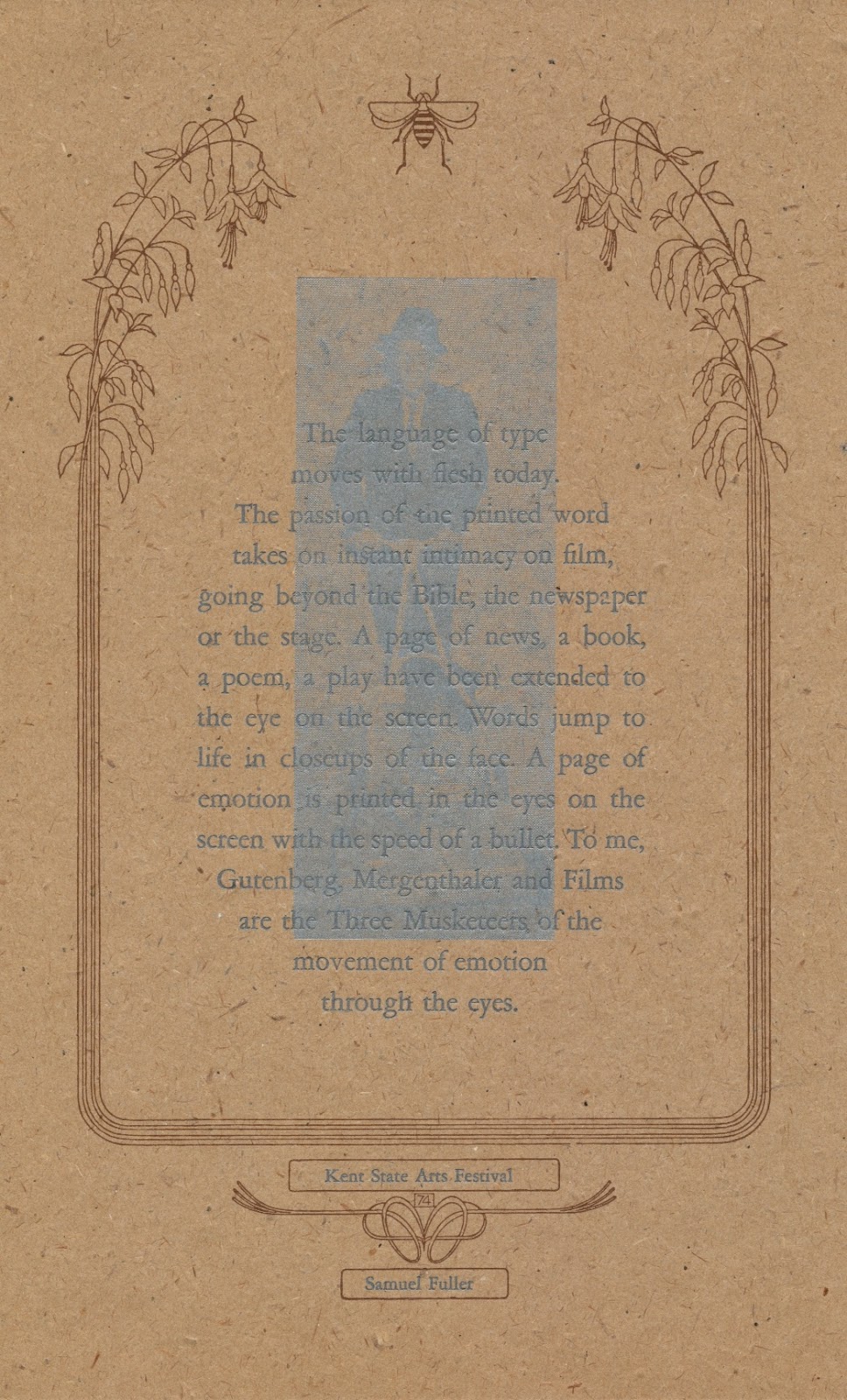
The portfolio also contains broadsides by Jennifer Dunbar, Ines Brolaski, Joanne Kyger, Barbara Einzig, Ed Dorn (2), Joel Oppenheimer, and Samuel Fuller. All are beautiful, especially those by Dorn, where each line of the work is typeset in a different font, and film-maker Samuel Fuller, who contributes a haunting text on the relationship between between typography and cinema which begins, "The language of type moves with flesh today." The text is overlayed onto a photograph of someone pushing a lawnmower (Johnston identifies the figure as Bing Crosby).
 |
| Samuel Fuller |
In the past I've often been dismissive of fine printing, thinking that it couldn't match the immediacy of mimeograph or xerox. After the recent exhibition we did on the Zephyrus Image, and after spending time with Alastair Johnston's excellent bibliography of the press, I've had to revise my opinion. Myers and Teter were masters of their craft, but were able to employ it to react with quickness and humor to the political and social events of their day, and in the case of this portfolio, were even able to take the show on the road. Were Michael Myers and Holbrook Teter the first punks of letterpress?
Zephyrus Image. 19 Kent State 74 Creative Arts Festival. Kent, Ohio: Zephyrus Image, 1974. First edition. 9 1/2 x 13 5/16" folder, illustrated at the front panel after a photograph by Eileen Mann, housing 9 broadsides of varying dimensions. Broadsides all fine; folder near fine with some light marginal creasing and a couple of small faint stains to rear panel. Johnston pp. 199-200, 79-81. SOLD.
Wednesday, May 2, 2012
The Irritable Tribe of Poets

Only three issues of Theo were published, but it still took me a couple of years to track down a complete set. I'd been fascinated by the magazine ever since I first ran across a copy of number 2, which has a rather unique design; the covers are stapled off center, so that the fore edge is layered; the front wrap ends before the first leaf, so that the name of each contributor is visible, and the rear wrap extends past the text block.

The editors had a sly sense of humor. The foreward to no. 1 notes that the name of the magazine "derived not from theology, but from Theo van Gogh, the tolerant brother of the insane artist." After the demise of Theo, co-editor Murphy went on to edit a magazine called "Vincent: The Mad Brother of Theo."
By the second issue the tagline evolved into "An honest collection from the irritable tribe of poets" (a nod to Horace). The description is an apt one. Much of the work in Theo shares something of a common rough-and-tumble aesthetic,
and there seems to be a definite focus on poets working away from the more urbane coastal scenes, including the Cleveland Scene. There is also work by a significant number of female poets. Number 1 includes a contribution from the African American artist Hart Leroi Bibbs, who will be the subject of an upcoming exhibition at Division Leap.
Other contributors include George Bowering, Kirby Congdon, Judson Crews, John Keys, Gloria Tropp, Jack Micheline, Erik Kiviat, Irene Schramm, Gerard Malanga, Duane Lock, Serge Gabronsky, George Dowden, William Wantling, Walter Lowenfals, Carol Berge, Paul Blackburn, Larry Eigner, Lynne Banker, Fred Bannon, Bob Blossoms, C. C. Chamberlain, Matteo Degennaro, Carl Ginsburg, Barbara Holland, Allan Katzman, Andrew Keiser, K.K., Amon Liner, Jim Mosley, Wayne Oaks, S. A. Osterlund, D. M. Pettinella, Ottone Riccio, Rai Saunders, Sid Shapiro, Susan Sherman, John Tagliabue, Tracy Thompson, L. S. Torgoff, Stephen Tropp, & Alex Weiner.
Issue no. 1 is an association copy, inscribed by George Montgomery to Joan Jonas. Montgomery was a contributor to all three issues of the magazine, and the afterword to no. 1 thanks him for making the publication possible.
Murphy, Frank & Jonas Kover, editors. Theo Nos. 1-3 [All Published]. New York: Theo Publications, 1963-65. First edition. 8vo. Mimeographed; saddle-stapled wraps. Association copy, with issue no. 1 inscribed by George Montgomery in the year following publication, with a Chinese character drawing. Some soiling,especially to no. 2, and some minor insect damage to the cover of no. 1, still a very good set. $250. Inquire.
Saturday, April 21, 2012
Mimeo Mimeo
I might be preaching to the choir here, as I bet that most readers of this blog already read or subscribe to Jed Birmingham and Kyle Schlesinger's Mimeo Mimeo, but if you haven't seen issue 6 buy it now, here.
The conceit behind this issue is deceptively simple. It prints new work by eight poets, all of whom were associated with the Mimeo Revolution to some degree - Bill Berkson, John Godfrey, Ted Greenwald, Joanne Kyger, Kit Robinson, Rosmarie Waldrop, Lewis Warsh, and Geoffrey Young. After I sat down and read through it, I was struck by how well these poets rub shoulders under these covers. I thinking the grouping is quietly provocative, because it forced me to see a commonality between these writers I had missed before. I call this quality consistency only for the lack of a better word. Out of the ephemerality and immediacy of the Mimeograph Revolution, all these writers have forged remarkably durable and ongoing bodies of work, and the work benefits from being presented together in this context. Also, laid into this issue is a multiple entitled Manufact Hologram by Robert Strong. I won't say anything about this piece, except that it is very, very cool and worth the price of admission alone.
Wednesday, April 11, 2012
Lucky Catalog #13
 |
| Catalog 13. Stab-stapled in sandpaper. The Division Leap crew no longer have fingerprints. |
Our lucky catalog #13 has just been issued. Highlights include art by Joe Brainard and Ray Johnson, Ray Johnson's first artist book, the flier for Andy Warhol's film Empire, signed by the cameraman, the first book ever designed to be a weapon, complete runs of several zines and magazines of the Mimeograph Revolution, Ed Sander's Fuck You Press, Graffiti, the student movements of 1968, Chicano low rider magazines, the Red Army Faction, Hip Hop, the Kommunication Liberation Front, No Wave, Hacktivism, and the Symbionese Liberation Army.
The pdf can be accessed here.
There are a handful of printed copies available, which are bound in sandpaper (apologies to Jorn and Debord). Email me if you'd like to receive one.
The Birth of An American Prayer

The original poster for this May 1969 reading at the Sacramento State College Gallery, which featured Jim Morrison of the Doors along with Michael McClure and D. R. Wagner. This was the first public reading of Jim Morrison's long poem "An American Prayer." It documents a watershed moment in Morrison's career as a poet, and is also a fascinating link between Morrison and the poetry of the Mimeograph Revolution. Around the time of this reading Morrison, after being shown some of Wallace Berman's publications by McClure, was inspired to publish his first poetry book, the Lords, in a loose leaf folder format. One has to assume that the publication was Semina. [Reference: Davis, Stephen. Jim Morrison: Life, Death, Legend pp. 130-1]
Yet another post in which I obsessively mention Wallace Berman.
Morrison, Jim and Michael McClure, D. R. Wagner. Reading and Show. Sacramento: SSC Gallery, nd. [1969]. 16 1/2 x 21 3/4", offset printed. Folded twice, with some toning along fold lines, else fine. SOLD.
From our upcoming lucky catalog no. 13, out in a matter of hours.
Tuesday, April 10, 2012
Wallace Berman, Lenny Bruce and Dinner with the Cops

The Digger Papers was the final Diggers publication. The entire contents also appeared as issue no. 81 of Paul Krassner's The Realist, but this edition was printed separately for free distribution in San Francisco, as had their previous leaflets - some of which are reprinted here, along with new material.
All the work in the Digger Papers is uncredited, in keeping with the Diggers non-attribution policy. I already knew that the book contained work by Gary Snyder and Richard Brautigan, but I was surprised to see a collage I recognized on one of the pages.
 | |
| "Untitled" (Lenny Bruce) by Wallace Berman |
It is a fascinating and beautiful page. Wallace Berman and Lenny Bruce both had problems with censorship and police response to their work. In Berman's case, the seizure of copies of Semina in the Ferus Gallery raid led to him withdrawing from the art world of the "City of Degenerate Angels." I wasn't aware of any connection between Wallace Berman and the Diggers. From reading Peter Coyote's memoir, I know that Billy Jahrmarkt (of Batman Gallery infamy) was associated with the Diggers - perhaps there are other links as well. The Diggers produced some of the most beautiful radical publications of the sixties, and this is a fascinating association with the Semina Circle and their work.
The Digger Papers. [San Francisco]: Free City, nd. [c. 1969]. Some spotty foxing and staining to the wraps, but very good.
From our upcoming lucky catalog no. 13, out in a matter of hours.
Monday, April 9, 2012
"The Hand Becomes a Framing Window"

Danieli, Fidel, ed. L.A. Artists' Publication Nos. 1-4 1/2 [All Published].
Los Angeles: L. A. Artists' Publication, 1972-73. Five numbers, each an unbound assemblage of posters, textpieces and pageworks housed in a printed envelope.
The entire run of this formally inventive artists' periodical from Southern California. Each artist was responsible for the printing of their own piece; they submitted their work along with a list of 25 people (later, 10 people) whom they thought would be interested in receiving the magazine. Includes contributions from the great Eleanor Antin (her piece 'Renunciations' in no. 1, and 'Domestic Peace' in no. 2), Betye Saar, Bob Haas, Jim Edson, Caroline Kent, John Beckman, and a variety of Mail Artists, including The Northwest Mounted Valise, John Dowd, Lowell Darling, and Dana Atchley. With it's unusual form of production and distribution the magazine provided a fascinating template for artists to communicate their work with each other and interested parties outside of the gallery system, somewhat in the spirit of other "newsletter" artists' periodicals such as Floating Bear and Semina - in fact, no. 2 contains a very cool homage to Wallace Berman by the editor.
 |
| "Wallace Berman: A Portrait" by Fidel Danieli |
From our upcoming lucky catalog #13, out this week.
Friday, March 30, 2012
All Traffic Lights Are Yellow

There is only one book about Peter-Ernst Eiffe, who is often referred to as the first graffiti artist in Germany. Eiffe's ludic and surrealist slogans were visible all over Hamburg during the tumultuous year of 1968, and became perhaps the most visible public texts of the German student uprisings. Eiffe frequently dressed in a suit and tie, and would often leave his business card near the site of his work; when a building used the contact information to issue him an invoice for damages to their property, he responded by sending them an invoice to pay for the artwork.
 |
| What station were you listening to, Eiffe? |
Eiffe's culminating action occured in May of 1968, when he drove his Fiat into Hamburg Central Station and began to write on the tiles until cops dragged him away. He was subsequently interred into a psychiatric ward. This book was published by his friend Uwe Wandrey in order to raise money for his cause. [Here is a profile I wrote about another great book published by Wandrey].
Eiffe was released from the ward later in the year, but in 1970 was interred into Rickling Psychiatric Hospital for depression. In 1982 he escaped, but died of exposure during the attempt.
Eiffe's life and work was the subject of a 1995 documentary film by Christian Bau.
This book is not only one of the most interesting publications of the German Student Movement, but is also an important and criminally overlooked artifact in the history of graffiti art. OCLC locates only the Deutsch Bibliothek copy.

Eiffe, Peter-Ernst. Eiffe for President: Fruhling Fur Europe. Surrealismen Zum Mai 1968. Hamburg: Quer-Verlag, 1968. Oblong 16mo. Stab-stapled in in cardboard covers, with a photographically illustrated pastedown to front panel. Illustrated with three black and white photographs. Text in German. Some expected toning to covers, as expected, with a light vertical crease to front and back panel, still a near fine copy of a very fragile book. According to some reports, as many as 3000 copies were sold, but it is likely that far fewer copies survive; the cardboard covers and fragile staple job make it almost impossible to open without breaking the binding. Inquire.
From our upcoming lucky catalog #13, out sometime next week.
Tuesday, March 20, 2012
The Object is Exorcism

The first and last issue of one of the most important little magazines of the sixties, edited and published by Ira Cohen from Tangiers. In Cohen's brief editorial statement he notes that the magazine is named for the ecstatic dancing and possession trances of the North African sect of the same name, and concludes that "The object is exorcism."
Reading Gnaoua almost fifty years later, it is striking how the work in these pages, produced by a number of hands, forms an almost seamless whole. Whether it be via cut-up or drugs or possession or linguistic manipulation, the writers in Gnaoua share a preoccupation with purposeful derangement to exorcise assumed literary forms. In his autobiography Harold Norse would say of his first cut-up piece included here, Sniffing Keyholes, that "I felt like I had broken through semantic and psychological barriers." The assembled magazine becomes a talisman of literary and social exorcism, and as such it makes a surprising appearance in one of the most iconic photographs of the sixties.
 | |
| What magazine would you take with you to the fallout shelter? |
Each item in the Daniel Kane photograph of Dylan which graces the cover of Bringing it All Back Home appears to be carefully curated, and the symbolism of each has been obsessively debated by record junkies in the years since. Gnaoua seems to have a place of prominence. It presides over the the scene from the mantelpiece, and, along with Sally Grossman's red dress is the focal point of color for the composition. It is a powerful symbol for an album in which Dylan would distance himself from the folk scene and the protest songs of yore and strike out in a new and more personal direction.
The writing in Gnaoua is uniformly strong. As well as excellent work by William S. Burroughs and Michael McClure it also prints for the first time Brion Gysin's essay "The Pipes of Pan", about the Master Musicians of Jajouka- an essay that would lead to the 1968 recordings of the group by Brian Jones. But the highlight for me is J. Sheeper's strange and beautiful manifesto Style - a work that demands to be reprinted. (I am indebted to David Abel for tipping me off that J. Sheeper is Irving Rosenthal). In this piece Rosenthal states that "The feelings books contain are real. Books should be covered in skin if you don't believe me." Gnaoua inaugurated a tendency to create the the printed object as a shamanistic talisman, and laid the groundwork for the beautiful experiments with woodblocks and handmade paper which Cohen would later undertake with Angus Maclise in Nepal under the Bardo Matrix and related imprints.
Cohen, Ira, ed. Gnaoua No. 1 [All Published]. Tangier: Gnaoua, 1964. First edition. 8vo. 103 pp. Offset printed and perfect bound in fuschia wraps illustrated by Rosalind. William S. Burroughs, Allen Ginsberg, Michael McClure, Jack Smith, J. Sheeper, Marc Schleifer, Mohammed Ben Abdullah Yussufi, J. Weir, Stuart Gordon, Tatiana, and Alfred Jarry. Wraps faded, heavily at the spine, which shows some old tidemarking; corner crease to one internal page; very good. SOLD.
Thursday, March 15, 2012
"Anything That Happens In the Life of a Poet Is Interesting"
I spent a large part of the day cataloging a stash of John Wilcock's Other Scenes. It was a trip in every sense of the word. Other Scenes was probably the most paripatetic of all the underground newspapers associated with the Underground Press Syndicate. It was published from so many different cities and countries that at times its itinerary and erratic numbering seems like a deliberate provocation. From how many different countries, and in how many different formats can you published the same paper?
The subject matter of Other Scenes was as varied as its itinerary. As its name suggests, it touches upon many scenes, and there are some interesting ties to the worlds of Fluxus, the Mimeograph Revolution, and the New York School.
In vol. 3, no. 3 I was astonished to find something I'd never seen before - a column by Ted Berrigan entitled "Under Shelley's Poet's Tree."

The page reproduces a drawing by George Schneeman and Ted Berrigan, and begins with something called Berrigan's Law, that 'anything that happens in the life of a poet is interesting." The column goes on to dish out gossip about many of the poets associated with the second wave of the New York School.
There's also this great, full page ad for the Something Else Press, which seems to appropriate an airplane ad. The text which overlays the airplane lists titles in print. The artist is unattributed - I'd love to know who designed it.

Wilcock, John, ed. Other Scenes: The International Newspaper. Third Battling Year, No. 3 March 1969. New York: Other Scenes, 1969. Folio, tabloid format. Offset printed on newsprint in color. Old fold line as usual, some minor toning, still a remarkably well-preserved, near fine copy. SOLD
Subscribe to:
Posts (Atom)